Ainda sem produtos na sua encomenda!

Data centers are now critical infrastructures that support the functioning of the digital economy. As the volumes of information processed and stored grow, driven by Artificial Intelligence (AI) and Machine Learning (ML), so do the energy requirements of these spaces.
It is estimated that the energy consumption of data centers could double between 2022 and 2026, with applications such as ChatGPT consuming up to 10 times more processing power than traditional search engines such as Google Search (Statista, 2024).
In this context, HVAC (Heating, Ventilation and Air Conditioning) systems play a strategic role: they guarantee energy efficiency, protect the physical integrity of equipment and contribute to the operational resilience of data centers.
Together with other strategies, such as those in the article ‘Energy Efficiency and Sustainability Measures in Data Centres’, Heating, Ventilation and Air Conditioning (HVAC) systems play an essential and complex role in data centers.
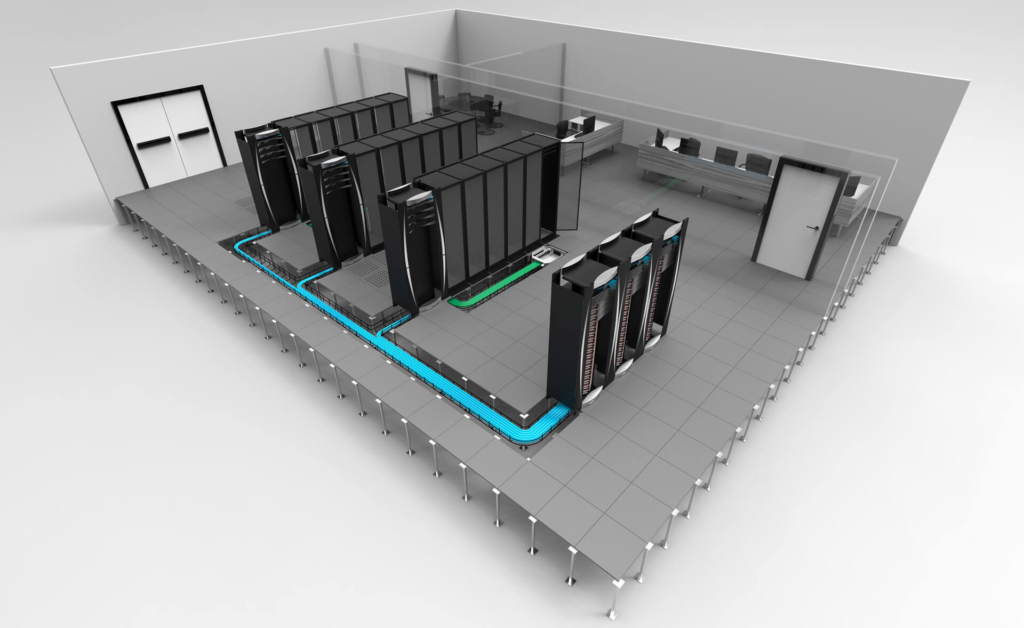
Unlike traditional buildings, data centers operate continuously, housing high-density electronic equipment that generates large volumes of heat. This requires highly precise climate control systems capable of maintaining stable temperature and humidity conditions to guarantee the performance and longevity of IT systems.
According to ASHRAE (American Society of Heating, Refrigerating and Air-Conditioning Engineers) recommendations, the ideal equipment environment specifications for air cooling are:
These values may vary depending on the class of equipment used, but respecting them is essential. When the temperature exceeds the set limits, computer equipment can automatically shut down, risking data continuity and security.
When an HVAC system is improperly dimensioned, has control failures or is not adapted to the geometry and thermal load of the space, the operational risks increase significantly:
The wrong choice of HVAC system in critical environments can compromise operational efficiency and safety. When choosing an Air Handling Unit (AHU) for data centers, it is essential to consider various criteria to ensure energy efficiency, reliability and suitability for the space available.
Hereafter, we highlight the main technical criteria to consider when selecting a AHU for Data Centers:
Technologies such as EC fans, with lower consumption and variable speed; optimised heat exchangers, with high sensible and latent heat transfer and low pressure drop; and low air resistance filters, which reduce the power required from the fans.
Depending on the project, thermal loads can be borne by the AHU alone or shared with other cooling equipment, always keeping the temperature within the defined parameters, which normally follow ASHRAE recommendations for the safe and efficient operation of servers.
A AHU for data centers must have advanced filtering systems capable of eliminating particles and contaminants, guaranteeing a clean and suitable environment for the equipment.
Modular units allow scalability and adaptation to different data center configurations and evolutions.
With real-time monitoring, automatic adjustments to environmental variations and alerts
Essential for extending the lifetime of the system and avoiding costly breakdowns, guaranteeing the continuous operation of the data center.
Ensuring the constructive quality, energy performance and safety of the equipment installed.
Specialised air conditioning in data centers is a determining factor in ensuring energy efficiency, operational continuity and equipment durability. In a context where every degree counts and where the margins for error are minimal, it is essential to choose HVAC systems that are reliable, modular and adjusted to the technical requirements of each project.
At OCRAMclima®, we develop tailor-made Air Handling Units (AHU), with integration into Building Management System (BMS), high energy efficiency and advanced filtering solutions. In addition to AHU, we offer complementary solutions that can be adapted to challenges such as data centers.
If you want to delve into the solutions available for your project, or obtain technical support in the process of specifying and selecting equipment, our sales team is available to support you.
Data centers are the backbone of the digital era, and despite already consuming more than 1% of global electricity, the path to sustainability is set.
With the rise of cloud computing, artificial intelligence, and the Internet of Things (IoT), the demand for data processing and storage is growing at an unprecedented rate. However, this massive expansion brings significant challenges: energy consumption, efficient cooling, environmental impact, and adequate infrastructure.
Reducing energy consumption and the environmental impact of data centers are crucial challenges in the digital age. Regarding energy efficiency, several strategies can help mitigate this situation.
Technology is advancing, but it is up to us to ensure that this evolution is sustainable. The path to more efficient data centers is already laid out—those who follow it will not only reduce costs but also lead the transformation toward a greener and more responsible future.
Discover our suggestions for ensuring efficiency and security in Data Centers:
More about Data Centers:
The data center market in Europe has seen significant growth in recent years and projections indicate that this trend will continue. In 2024, the European data center market was expected to reach 12,23 thousand MW, with an annual growth rate of 7.96%, thus reaching more than 17,93 thousand MW by 2029.
It is estimated that there are over 8,000 data centers worldwide, the largest cluster being in Northern Virginia with over 300 data centers and an energy consumption capacity of 2,552MW.
Portugal, despite being pointed out as a hub and gateway to the world in terms of interconnection, has 35 data centers, although more investment in this sector is planned.
In Europe, the UK is the country with the biggest environmental footprint. The data centers operating out of London require 1,053 MW. On the same list, the second European city with the most installed capacity is Frankfurt, with 864 MW.
Globally, the second region with the most computing capacity is Beijing, with 1,799 MW, which remains the only Asian city to need more than 1,000 MW to power its data centers. The data centers already installed in Tokyo, for example, consume 865 MW.
This growth is driven by several factors, including the increased use of data, the growing demand for cloud computing services and the need for robust e-commerce systems. In addition, the expansion of emerging technologies such as artificial intelligence (AI) and edge computing is contributing to increasingly advanced data center infrastructures.
However, this growth brings with it significant challenges, especially with regard to energy consumption. According to the European Commission, data centers in Europe used 259 TWh of electricity by 2020, representing 1.7% of the world’s total energy consumption. With the market expected to generate 30 times more data over the next ten years, a corresponding increase in energy consumption is expected. Consequently, there is an increasing focus on reducing energy consumption, consolidating wide area networks (WAN) and bandwidth requirements, creating opportunities for the data center interconnection market.
Known as ‘the new vaults’ because they house servers and storage systems, data centers are physical infrastructures designed to store, process and distribute large volumes of data and digital applications. They support the IT operations of companies, governments and internet service providers.
Due to the high energy consumption and environmental impact, there is an increasing focus on the energy efficiency and sustainability of data centers, including the use of renewable sources and advanced cooling technologies.
The future of data centers in Europe looks promising, with continued growth driven by digitalisation and the adoption of new technologies. However, it will be crucial to address the challenges related to energy consumption and sustainability to ensure a balanced and responsible development of the sector.
